
Application Overview
The system collects status data such as water level in the pumping station’s storage tanks, as well as pipeline pressure and flow rate, and transmits the data to the platform via a wireless network. When an anomaly is detected, an alarm is promptly triggered, and fault information is sent to staff to ensure the normal operation of the water supply system.
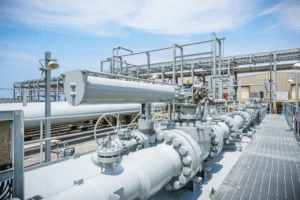
Process control and monitoring of water supply pumping stations
Water supply pumping stations are of various types (such as centralized urban water supply pumping stations, dedicated pumping stations for industrial parks, and emergency backup pumping stations). They are core infrastructure of urban water supply and drainage systems. According to the “Design Code for Urban Water Supply Pumping Stations” (CJJ 120-2008), their core functions include raw water lifting (transporting water from the source to the water plant), clean water pressurization (delivering purified water to the pipe network to meet pressure requirements), secondary water supply pressurization (solving insufficient water pressure in high-rise residential buildings), and emergency storage. As the “power center” for water security, water supply pumping stations cover 100% of cities at the county level and above.
From an industry technical perspective, water supply pumping stations must meet the “Test Procedure for Pumping Station Efficiency” (GB/T 30948-2014), with core operating indicators including pump unit efficiency ≥75%, flow monitoring error ≤±2%, and liquid level control accuracy ≤±5mm. They must also comply with the “Urban Water Supply Quality Standard” (GB 5749-2022), ensuring stable water quality through precise parameter control. Their importance lies not only in ensuring people’s livelihoods but also in supporting key sectors such as industrial production (accounting for over 85% of industrial water supply).
With 15 years of technological accumulation in the water industry, Chinese manufacturer Brand A has achieved large-scale application of its flow meters, flow sensors, level gauges, quantitative control systems, and data loggers in more than 100 water supply pumping stations across the country, effectively solving many pain points in traditional operations.
- Existing problems
Taking the core water supply pumping station in Dongping County of the province as an example, the pumping station serves a population of 800,000, covering the urban area and three surrounding towns, undertaking 70% of the county’s water supply tasks, while also taking into account the special water supply for the industrial park. Before introducing A brand equipment, it faced four major pain points for a long time.
1.1 Inaccurate flow monitoring : The old-fashioned mechanical flow meter is affected by water impurities, resulting in an average monthly error of 8%-12%. This not only leads to disputes over water volume settlement data with downstream township water plants, but also fails to provide accurate basis for pump load adjustment, and is prone to unstable pipeline pressure during peak water consumption periods.
1.2. Delayed liquid level control : Manual inspection records of liquid level data are kept at intervals of up to 2 hours, which cannot respond in a timely manner in sudden scenarios such as heavy rain or peak water usage. The liquid level has caused the pool to overflow due to exceeding the limit, which not only wastes water resources but also increases the risk of water pollution. At the same time, low liquid levels can easily cause the pump set to run dry and damage the equipment.
1.3. Uncontrolled quantitative water supply : The timed and quantitative water supply for enterprises such as electronics and food processing in Dongping County Industrial Park relies on manual operation. The deviation of a single water supply can reach as high as 15%, which cannot meet the requirements of enterprises for water stability in their production processes, affecting product quality and causing frequent complaints from enterprises.
1.4. Lack of Data Traceability : The use of paper records for operational data makes them prone to damage and loss, failing to provide complete historical data and thus unable to support operational optimization. Furthermore, it lacks effective data support for tracing water quality anomalies and troubleshooting equipment malfunctions.
- Core Requirements: Precise, intelligent, and traceable operational upgrades
Based on the above issues and considering the full-process requirements of the pumping station—from raw water delivery to clean water storage, diversified water supply, and operation and maintenance supervision—three core objectives are defined. First, precise monitoring across all scenarios, requiring flow measurement errors in different stages such as raw water, clean water, and industrial water supply to be controlled within ±1%, and level monitoring accuracy in key water storage facilities such as the raw water regulating tank and clean water tank to reach ±2mm, capturing real-time changes in water volume at each stage. Second, intelligent control across multiple scenarios, achieving automatic adjustment of water tank levels (automatic start and stop of pump units when the level is below 1.2 meters or above 3.8 meters), while simultaneously meeting the customized quantitative water supply needs of different enterprises in the industrial park—1-4 times daily, with each supply ranging from 200-800 cubic meters—with a deviation not exceeding ±3%. Finally, full-cycle data traceability, automatically recording flow rate, level, pump unit operating parameters, and equipment fault information, storing data for at least 3 years, supporting Excel export and anomaly data annotation, meeting the needs of regulatory auditing, fault tracing, and operational optimization.
2.1. Precise monitoring requirements : The flow measurement error is controlled within ±1%, the liquid level monitoring accuracy reaches ±2mm, and the flow changes of raw water inlet, clean water outlet and zoned water supply are captured in real time to provide data support for settlement and scheduling.
2.2. Intelligent control requirements : To achieve automatic adjustment of the water tank level, and to automatically start and stop the pump group when the water level is below 1.2 meters or above 3.8 meters; to meet the quantitative water supply of 500 cubic meters three times a day to the industrial park, with a deviation of no more than ±3%.
2.3. Data traceability requirements : Automatically record parameters such as flow rate, liquid level, and pump operation, store data for no less than 3 years, support Excel export and abnormal data annotation, and meet the requirements of regulatory audit and flood control subsidy application.
- Solution: Deployment of Brand A’s entire supply chain equipment system
In response to the demand, Brand A deployed corresponding equipment at key nodes around the core process of the pumping station, covering diverse application scenarios, clarifying the role of each piece of equipment, and achieving precise control over the entire chain.
3.1. Flow Meter: Application scenarios include raw water inlet main pipe (1 unit), clean water outlet main pipe (2 units), and dedicated water supply branch pipes for various enterprises in industrial parks (9 units), adaptable to different scenarios such as urban water supply and customized industrial water supply. Its function is to accurately measure the water flow in each pipe using 316L stainless steel electrodes, with a data sampling frequency of up to 10Hz, providing authoritative data for water volume settlement, pipeline pressure regulation, and industrial water supply quota management, solving the problem of inaccurate flow monitoring in different scenarios.
3.2. Flow Sensors: Matching flow meters are deployed at pump station outlets (1 per pump station, 12 in total) and pipeline pressure distribution nodes (12 in total), used for pump station output monitoring, pipeline leakage investigation, and other scenarios. Their function is to collect real-time flow data from various nodes, forming a three-dimensional monitoring network of “main trunk + branches + equipment” with the flow meters. When the flow rate of a pump station is abnormal or the flow rate in a certain area of the pipeline drops suddenly, an alarm is immediately triggered, helping to quickly locate pump station faults or pipeline leaks.
3.3. Level Gauge: Application scenarios cover raw water regulating tanks (2 units), clear water storage tanks (4 units), and emergency backup water tanks (2 units), adaptable to different water storage scenarios such as large-capacity water storage and emergency water storage. It adopts a dual monitoring mode of ultrasonic + hydrostatic pressure, accurately capturing level changes under different scenarios (accuracy ±2mm). In sudden scenarios such as heavy rain (rapid rise in raw water regulating tank level) and peak water usage (rapid drop in clear water tank level), it sends a signal to the control system within 0.5 seconds, automatically triggering the pump group to start/stop or switch, preventing overflow, water shortage, and equipment idling problems.
3.4. Quantitative Control System: This system is used in industrial park water supply control units. It addresses the diverse needs of different enterprises, such as electronics companies requiring low-flow, high-frequency water supply and food processing companies requiring high-flow, timed water supply. It deploys one PLC quantitative controller and 12 pump control modules. Its function is to preset 20 water supply schemes, receive real-time data from the corresponding branch pipe flow meters to form a closed-loop regulation system, and automatically control the pump start-up, shutdown, and speed to meet the customized water supply needs of different enterprises and ensure the stability of water used in production processes.
3.5. Data Logger: Application scenarios cover the data terminal in the central control room of pump stations. It integrates full data acquisition functions such as flow rate, liquid level, pump unit operation, and equipment failure, adapting to different scenarios such as daily operation and maintenance, emergency dispatch, and fault tracing. Its function is to automatically collect data from various devices, supporting instantaneous flow rate and cumulative flow rate recording. Historical data curves can be viewed via a computer, and data such as abnormal flow rate and excessive liquid level are automatically marked, providing data support for operation and maintenance personnel to troubleshoot and optimize pump unit operation plans.
3.5.1. Flow meter: Deployed in the core water transmission pipeline to achieve accurate flow measurement.
Application scenario: A total of 12 Brand A electromagnetic flow meters are deployed on the raw water inlet main pipe, the clean water outlet main pipe, and the dedicated water supply branch pipes for industrial parks. The main pipe flow meters are responsible for overall water flow measurement, while the branch pipe flow meters provide accurate statistics for the water supply in different zones.
Core function: Using 316L stainless steel electrodes, it is suitable for pumping stations with turbidity water quality of 0-500NTU, with a data sampling frequency of 10Hz and measurement error controlled within ±0.8%. It collects flow data of each stage in real time and transmits it to the control center via 485 bus, completely solving the problem of mechanical meter inaccuracy and providing authoritative data for water consumption settlement.
3.5.2. Flow sensor: Used in conjunction with a flow meter to achieve zoned flow monitoring.
Application scenario: 24 Brand A insertion flow sensors are deployed at various sub-nodes such as water supply branch pipes and pump set outlets to form a “main trunk + branch” monitoring network with the flow meter.
Core function: Accurately captures changes in flow rate in different zones, providing data support for pump load regulation and leakage investigation. When the flow rate in a branch pipe fluctuates abnormally, an alarm is immediately triggered to help quickly locate the problem.
3.5.3. Level gauge: Deployed in water storage facilities to achieve automatic monitoring of liquid level.
Application scenario: Eight key monitoring points in the raw water regulating tank and clear water storage tank are monitored using A brand ultrasonic level gauges, combined with static pressure level sensors to form dual monitoring.
Core function: Real-time collection of water level data in the pool. When the water level is below 1.2 meters (low water level threshold) or above 3.8 meters (high water level threshold), a signal is immediately sent to the control system to automatically trigger the pump group to start and stop. The response time is ≤0.5 seconds, eliminating overflow and water shortage problems caused by the lag in manual inspection.
3.5.4. Quantitative Control System: Deployed in industrial water supply units to achieve customized water supply.
Application scenario: Dedicated control area for industrial water supply in pumping stations, equipped with a Brand A PLC quantitative controller, to build a closed-loop control system for customized water supply needs of industrial parks.
Core function: It has 12 preset water supply schemes and automatically adjusts the start-up, shutdown, and speed of the pumps after receiving real-time data from the flow sensor to achieve “on-demand water supply.” For example, for an industrial park with a daily demand of 500 cubic meters three times a day, it can precisely control the water supply deviation and ensure a stable water supply for production in the park.
3.5.5. Data Logger: Deployed in the central control room to achieve end-to-end data retention.
Application scenario: Integrated into the central control terminal of the pumping station, it accesses all equipment operation data to form a unified data management platform.
Core functions: Supports instantaneous and cumulative traffic recording and data retention; allows remote viewing of historical data curves via computer and mobile phone, and automatically marks abnormal parameters, meeting regulatory audit requirements and providing data support for operational optimization.
- Application Results: Dual Improvement in Operational Efficiency and Benefits
One year after the equipment was put into operation, the operational indicators of the pumping station in various scenarios were fully optimized, and the core functions were significantly improved.
4.1. Precise monitoring covering all scenarios: The flow meter and flow sensor work together to stabilize the flow measurement error in different scenarios such as raw water, clean water and industrial water supply within ±0.8%, reduce the water billing dispute rate to 0, reduce the fluctuation range of pipeline pressure by 60%, and completely solve the problem of unstable water pressure for residents during peak water use periods.
4.2. Intelligent control adapts to multiple needs: The level gauge enables 24-hour automatic monitoring of all water storage facilities, with water level fluctuations controlled within ±5mm. The incidence of overflow and water shortage accidents is 0, and the phenomenon of pump idling is completely eliminated. The quantitative control system meets the different water supply needs of enterprises in multiple industrial parks, with water supply deviations stable at ±2.5%. The stability of water used in enterprise production processes is improved, and the number of related complaints has been reduced to an average of 0.3 times per month.
4.3. Data traceability supports the entire process: The data logger accumulates and stores data, and can provide customers with accurate support for water use scheduling based on complete historical data of liquid level and flow rate, successfully avoiding the risk of exceeding the limit of the raw water equalization tank liquid level twice; in the troubleshooting of two pump set failures, the cause of the failure was quickly located by using historical operating data, and the repair time was shortened by 70%.
4.4. Excellent equipment adaptability and stability: The entire set of equipment is adaptable to the water quality and operating conditions of different scenarios such as raw water, clean water, and industrial water supply. The annual failure rate is only 0.5%, which is far lower than the industry average of 2%. Brand A’s after-sales service responds promptly, reducing equipment downtime for maintenance by 60%, ensuring continuous and stable operation of the pumping station, and increasing the water supply guarantee rate for residents and enterprises to 99.9%.
4.4.1. Precise flow monitoring and zero settlement disputes : The flow meter and flow sensor work together to stabilize the flow measurement error at ±0.8%, which is far better than the target requirement of ±1%; the annual water settlement dispute rate is reduced to 0, reducing economic losses by about RMB15,000 per month and increasing revenue by more than RMB180,000 per year.
4.4.2. Automated liquid level control, zero safety risks : The liquid level gauge achieves 24-hour real-time monitoring and automatic control, and the water level fluctuation range of the pool is controlled within ±5mm. The occurrence rate of overflow and water shortage accidents is 0. The pump set idling rate is reduced by 30%, saving an average of RMB 23,000 in electricity costs per month and more than RMB 276,000 per year.
4.4.3. Precise quantitative water supply leads to a surge in customer satisfaction: The quantitative control system stabilizes the deviation of industrial water supply at ±2.5%, lower than the target of ±3%; the number of enterprise complaints has dropped to an average of 0.3 times per month, and customer satisfaction has increased from 82% to 98%, earning joint recognition from enterprises in the park.
4.4.4. Standardized Data Management, Fully Realizing Value : Data loggers accumulate data storage, and pump unit operation plans are optimized based on historical data, resulting in a 40% reduction in operation and maintenance costs.
4.4.5. Stable equipment operation and significantly reduced maintenance pressure : The annual failure rate of the entire set of equipment is only 0.5%, far lower than the industry average of 2%; Brand A’s after-sales service response time is ≤2 hours, and the equipment downtime for maintenance is reduced by 60%, ensuring the continuous and stable operation of the pumping station.
As a leading brand manufacturer in China, A has the responsibility and commitment to provide effective solutions and professional technical guidance to customers in the water supply pumping station industry, improve the efficiency of water supply pumping stations, and provide a high-quality life for the public and businesses.