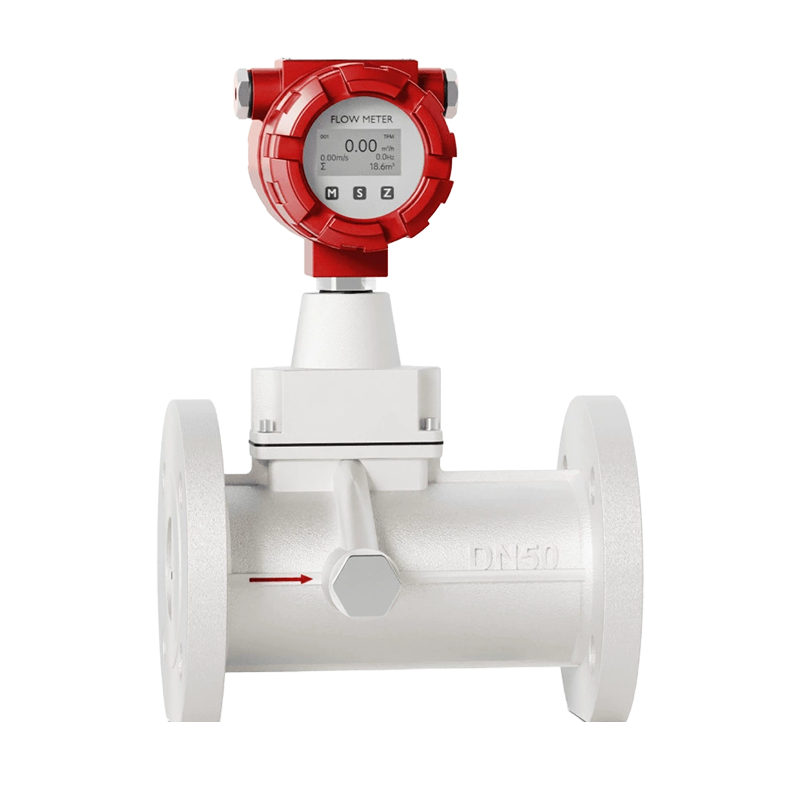
Working principle of vortex flow meter
Vortex flow meters utilize the Karman vortex street principle for measurement. A cylindrical column is vertically inserted into the measuring tank. As fluid passes through the column, under certain conditions, two rows of regularly spaced vortices are alternately generated on both sides of the column. As shown in the figure below, these two rows of vortices are called the “Karman vortex street.” The released vortices are most stable when d/D = 0.281. The frequency of the Karman vortex street is related to the fluid flow velocity and the width of the column, and can be simply expressed by the following formula:
-
F = S(t)× V/d
-
F: Release frequency of the Karman vortex street
-
St (:) Coefficient (called the Stroha number)
-
V: Fluid flow velocity
Basic characteristics
-
Better seismic performance
-
The lower limit flow velocity is low, reaching 1/2 to 1/4 of that of a conventional vortex flow meter.
-
It has a wide range ratio, typically ranging from 1:30 to 1:50.
-
The debugging and operation are simple, and it has HART communication function (optional).
-
Instantaneous flow rate display, cumulative total display, percentage display, frequency display
-
4~20mA output, 0~5kHz frequency output, vortex pulse output
-
It features Chinese and English menus, making it easy to read and understand.
Application areas
-
The YCLUG series vortex flow meter is a stress-type vortex flow meter whose design incorporates extensive experience and boasts superior performance.
-
It is an internationally advanced vortex flow meter developed based on the Karman vortex street principle. It is suitable for measuring the volumetric flow rate and mass flow rate of superheated steam, saturated steam, compressed air, and general gases and liquids.
-
Widely used in metallurgy, papermaking, water treatment, chemical industry, light industry and textiles, food and beverage, catering, agricultural irrigation, hydropower stations, oil fields, power and mining industries.
Advantages that distinguish it from other vortex flow meters
The YCLUG series vortex flowmeter employs digital signal processing (DSP) technology in its signal processing circuit, incorporating a 14-stage digital bandpass filter. Through a Fast Fourier Transform (FFT) software algorithm, it improves the signal detection sensitivity of the vortex flowmeter, enhances its vibration resistance, and overcomes the limitations of traditional analog methods for processing vortex signals. The intelligent vortex converter utilizes a variable gain amplifier to adapt to the signal strength of various vortex sensors and a variable bandwidth multi-stage filter for effective preprocessing of the vortex signal. Finally, DSP technology is used in the software to implement a 14-band adaptive bandpass filter algorithm.
Generally, intelligent vortex converters can extend the lower limit of vortex flowmeter measurement to 1/2-1/4 of the original value, thereby expanding the range of the vortex flowmeter. This model of vortex converter adopts a potentiometer-free design, and all debugging is completed by button settings, which facilitates on-site debugging and improves the reliability of the instrument.
Technical parameters
-
Nominal thread diameter DN: 25, 32, 40, 50, 65, 80, 100, 125, 150, 200, 250, 300
-
Nominal pressure (MPa): 1.0, 1.6, 2.5, 4.0, 6.3
-
Structural forms: clamp connection type, flange connection type, insertion type
-
Sensor material: 316L
-
Body material: 304 stainless steel
-
Fluid temperature: Medium temperature type ≤280℃; High temperature type >280℃
-
Explosion-proof markings: There are two types: non-explosion-proof and flameproof.
-
Accuracy class: 1.0
-
Repeatability: 0.33%
-
Range ratio: 10:1
-
Measurable flow velocity range: Gas: 5~50 (m³) /s (extended to 3~60 m³ (/) s); Liquid: 0.5~5 m³ (/) s (extended to 0.3~6 m³ (/) s)
-
Power supply: 18V-24VDC or 12VDC, or 3.6V lithium battery.
-
Output: 4-20mA or frequency output, vortex pulse output
-
Electrical interface: M20×1.5
-
Protection rating: IP65
-
Power-off data retention time: The power-off memory EEPROM ensures that the set parameters and flow accumulation data are permanently retained after a power outage.
-
Traffic flow display: Instantaneous traffic flow display, cumulative total display, percentage display, frequency display
-
Multiple flow rate units: m³ (/) h, I/h, kg/h, m³ (/) m, I/m, G/s, G/m, G/h
-
Multiple output modes: 4~20mA output, 0~5kHz frequency output
Vortex Flow Meter Selection Table
| YCLUG | Vortex flow meter | ||||||
| code name | Installation method | ||||||
| AND | Clamping type | ||||||
| F | Flange type | ||||||
| I | Insert type | ||||||
| code name | Nominal Through Diameter | ||||||
| 25 | DN25 | ||||||
| 32 | DN32 | ||||||
| … | … | ||||||
| 300 | DN300 | ||||||
| code name | medium | ||||||
| Q | gas | ||||||
| L | liquid | ||||||
| code name | Output signal | ||||||
| J | Local LCD display, no output | ||||||
| P | Pulse output, no display | ||||||
| A | 4~20mA output with LCD display | ||||||
| code name | pressure | ||||||
| 16 | PN1.6 | ||||||
| 25 | PN2.5 | ||||||
| 40 | PN4.0 | ||||||
| code name | temperature | ||||||
| M | t ≤ 280℃ | ||||||
| H | t > 280℃ | ||||||
To select the correct vortex flow meter, the following process parameters need to be understood in detail:
-
Fluid name and composition: Determine if a vortex flow meter can be used for measurement.
-
Maximum fluid temperature and corrosiveness: Determine if a vortex flow meter can be used and the appropriate materials.
-
Pipe inner and outer diameters, common flow rate, normal flow rate, minimum flow rate: Determine the appropriate flow meter diameter to select.
-
Maximum and minimum operating pressures: Determine the pressure rating of the flow meter.
-
Process connection method: Determine whether to choose clamp type or flange type.
-
Installation environment: Determine the protection rating of the flow meter.