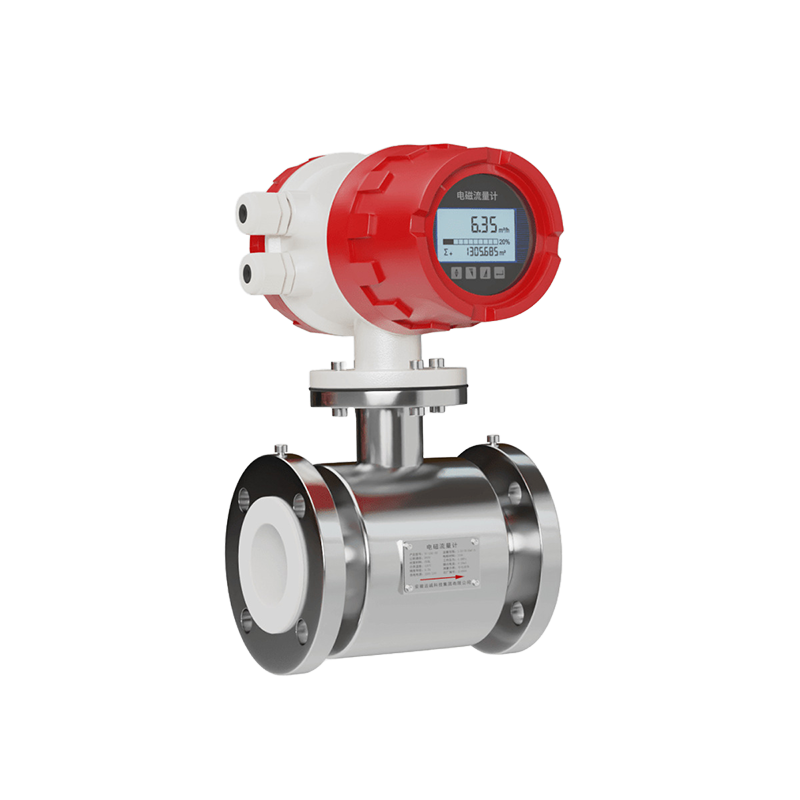
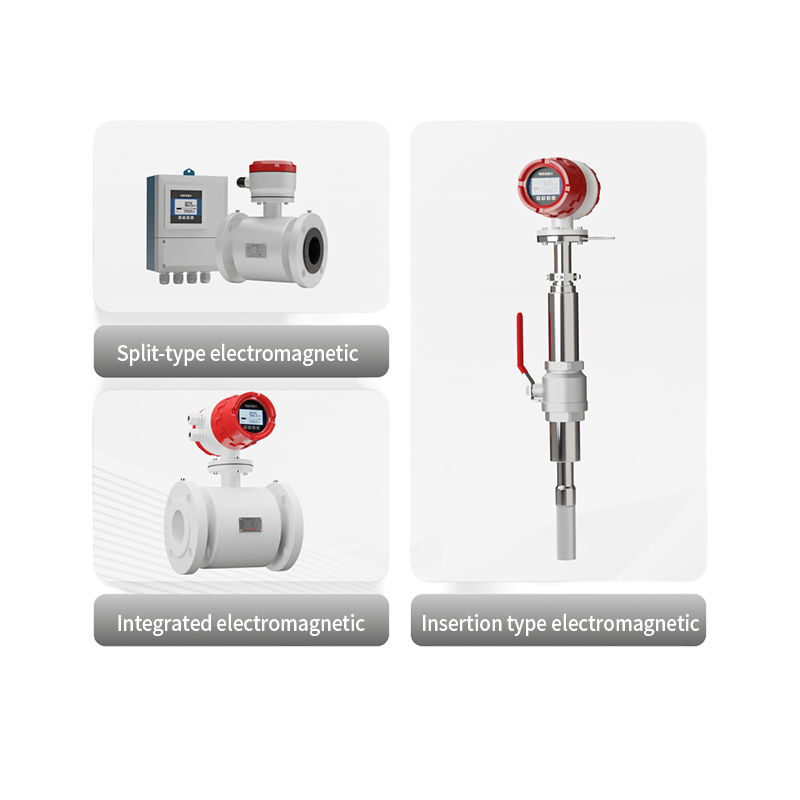
Electromagnetic flowmeter measurement principle
The DILD82 electromagnetic flowmeter operates on the principle of Faraday’s law of electromagnetic induction. That is, when a conductive liquid moves through a magnetic field, cutting magnetic lines of force, an induced electromotive force (EMF) is generated in the conductor. This induced EMF is:
-
E = KB V D;
-
K: Instrument constant
-
B: Magnetic induction intensity
-
V : Average flow velocity within the cross-section of the measuring tube
-
D: Inner diameter of the measuring tube
When measuring flow rate, the fluid flows through a magnetic field perpendicular to the flow direction. The flow of the conductive liquid induces a voltage proportional to the average flow rate (i.e., volumetric flow rate). This voltage is detected by two electrodes in direct contact with the liquid, transmitted to an amplifier, and then converted into a uniform output signal.
Measurement characteristics
-
There is no obstruction to the fluid inside the measuring tube, therefore there is no pressure loss.
-
Since the signal is formed throughout the entire space filled with the magnetic field, it is an average value across the pipe cross-section, so the required main pipe section is relatively short, with a front end length of DNx5 (DN is the flow meter diameter).
-
Only the pipe lining and electrodes are in contact with the liquid being measured. Therefore, by properly selecting the electrode and lining materials, the requirements for corrosion resistance and wear resistance can be met.
-
The measured signal is an electromotive force that is linearly related to the average flow velocity. It is independent of the liquid’s physical parameters such as pressure, temperature, density, viscosity, and conductivity (not less than the minimum conductivity), so the measurement accuracy is high and the operation is reliable.
Significant features
-
Good measurement stability and economical application
-
The user interface is available in both Chinese and English, and is simple and easy to use.
-
With a wide power supply range of AC, 85V~265VDC, and 18V~38V, it is suitable for both domestic and export use.
-
It has an automatic zeroing function, the zero point is very stable, and the flow rate will not be displayed when the pipe is empty.
-
Capacitive empty/full tube detection technology, fault self-diagnosis technology, and alarm prompts
-
The lightning protection circuit features a high-efficiency anti-interference circuit that has passed the national EMC electromagnetic compatibility test and is suitable for various harsh working conditions.
-
It features a pluggable EPRON, storing flow meter configuration parameters and flow detection data without data loss during power failure.
-
Multiple excitation modes are available, including 3.125Hz, 6.25Hz, 12.5Hz, and 25Hz.
-
It features a cumulative quantity preset function to meet the requirements of customers such as oil fields who need to set “baseline data”.
-
The frequency output can be configured to indicate either reverse flow (always outputting a low level) or forward flow (always outputting a high level).
-
It can measure forward/reverse flow.
-
Each unit is inspected before leaving the factory.
Technical parameters
-
Nominal diameter: DN6 ~ DN2800
-
Rated pressure: PN0.6, PN1.0, PN1.6, PN2.5, PN4.0, PN6.4, PN10, PN16, PN25 MPa
-
Lining: Polytetrafluoroethylene (PTFE), Chloroprene rubber (CR), Perfluoroethylene propylene (F46), Polyurethane (PU)
-
Electrodes: 316L, titanium, Hastelloy B, Hastelloy C, tantalum, platinum, tungsten carbide
-
Power supply: 220V AC +20/-60%, 50/60H2, 24VDC +50/-25%, max. 10VA, battery powered.
-
Display: Large LCD screen with a user-friendly interface, easy to use. Displays instantaneous flow rate, total volume, flow rate, etc.
-
Language: Chinese and English can be switched freely
-
Output: 4~20mA: Active output; Pulse signal: Passive output
-
Display units: Instantaneous flow rate can be displayed in the following units: m³/h, m³/m, m³/s, L/h, L/m, L/s, G/h, G/m, G/s. Cumulative flow rate can be displayed in the following units: m³, L, G, etc. (Note: G is an imperial unit: gallon)
-
Communication protocols: Optional RS485 (MODBUSE protocol), HART protocol
-
Connection method: Flange connection
-
Measurement range: 0.05m/s~12m/s
-
Measurement accuracy: 0.5% within the range of 0.3 m/s to 10 m/s.
-
Protection rating: P65 for integrated unit, P68 for split unit (optional)
-
Explosion-proof rating: Not explosion-proof and flameproof
-
Ambient temperature: -30-65℃
-
Ambient humidity: <85% RH (non-condensing)
-
CE Certification: Based on LVD2006/95/EC and EMC 2004/108/EC , EN 61326-1:2006 Radiation Standard (declared compliance with BS EN50081-1) , EN 61326-1:2006 Immunity Standard (declared compliance with BS EN50082-1), and EN 61010-1:2001 Safety: Part 1: General Requirements.
Electromagnetic Flowmeter Selection Table
| DILC82 | Electromagnetic flowmeter | ||||||||
| code name | Connection method | ||||||||
| AND | Flange connection type | ||||||||
| J | Clamping type | ||||||||
| F | Insert | ||||||||
| code name | Nominal Through Diameter | ||||||||
| 6 | DN6 | ||||||||
| 8 | DN8 | ||||||||
| … | … | ||||||||
| 1600 | DN1600 | ||||||||
| 2800 | DN2800 | ||||||||
| code name | Pressure level | ||||||||
| 6 | PN0.6 | ||||||||
| 10 | PN1.0 | ||||||||
| 16 | PN1.6 | ||||||||
| 25 | PN2.5 | ||||||||
| 40 | PN4.0 | ||||||||
| 64 | PN6.4 | ||||||||
| code name | lining | Scope of application | |||||||
| 1 | Chloroprene rubber (DN≥DN65) | Water, sewage, mildly abrasive mud, slurry | |||||||
| 2 | Perfluoroethylene F46 | Highly corrosive media such as concentrated acids and alkalis | |||||||
| 3 | Polytetrafluoroethylene (PTFE) (DN≥DN25) | Highly corrosive media such as concentrated acids and alkalis | |||||||
| 4 | polyurethane rubber | Neutral, highly abrasive slurries, coal slurries, and mud | |||||||
| code name | electrode | Scope of application | |||||||
| A | 316L stainless steel | It is used for weakly corrosive media such as industrial water, domestic water, and sewage, and is widely used in industries such as petroleum, chemical, urea, and vinylon. | |||||||
| B | Hastelloy B | It exhibits excellent corrosion resistance to hydrochloric acid of all concentrations below its boiling point, and is also resistant to corrosion from non-oxidizing acids, alkalis, and non-oxidizing salt solutions such as sulfuric acid, phosphoric acid, hydrofluoric acid, and organic acids. | |||||||
| C | Hastelloy C | It is resistant to corrosion from oxidizing acids, such as nitric acid, mixed acids, or mixtures of chromic acid and sulfuric acid. It is also resistant to corrosion from oxidizing salts such as FeS, Cu, or other oxidizing agents, such as hypochlorite solutions above room temperature and seawater. | |||||||
| D | tantalum electrode | It has excellent corrosion resistance, similar to glass, and can withstand the corrosion of almost all chemical media (including hydrochloric acid, nitric acid, sulfuric acid and aqua regia) except for hydrofluoric acid, fuming sulfuric acid and alkali. | |||||||
| P | titanium | It is resistant to seawater, various oxides, hypochlorous acid, oxidizing acids (including fuming nitric acid), organic acids, and alkalis, but not resistant to relatively pure reducing acids (such as sulfuric acid and hydrochloric acid). However, if the acid also contains oxidizing agents (such as nitric acid, Fe3+, Cu2+), its corrosiveness is greatly reduced. | |||||||
| T | Platinum | It works for almost all chemicals, but not for aqua regia and ammonium salts. | |||||||
| code name | powered by | ||||||||
| 0 | 24VDC | ||||||||
| 1 | 220VAC | ||||||||
| 2 | 3.6V battery powered | ||||||||
| code name | Waterproof rating | ||||||||
| 0 | Integrated IP65 | ||||||||
| 10 | Split type IP65 | ||||||||
| 11 | Split type IP68 | ||||||||
| code name | communication | ||||||||
| N | No communication protocol | ||||||||
| R | With RS485 | ||||||||
| H | With Hart protocol | ||||||||
| code name | Grounding | ||||||||
| N | none | ||||||||
| AND | grounding electrode | ||||||||
| R | grounding ring | ||||||||
Product Information
| model | Appearance | Product Name | Related instructions |
| YCLDG | Electromagnetic flowmeter | View the electromagnetic flowmeter user manual online > |